Singapore GST F5 Return Explained: What Goes in Boxes 1 to 8
Filing a GST F5 return in Singapore? What goes in Boxes 1 to 8, one real quarter worked through, and the three entries that trip people up.
Every GST-registered business in Singapore files a GST F5 return, usually once a quarter, and the form looks more complicated than it is. It has more boxes than most businesses ever use, but for a typical small service business, Boxes 1 to 8 do the work: what you sold, what you bought, the GST on each, and the difference between the two. Get those eight right and the rest are usually zero or straightforward.
This guide walks through those boxes one at a time, then fills them in for one real quarter, so you can see exactly where each sale and purchase lands, including the three that trip people up: a sale to an overseas client, an invoice that hasn't been paid yet, and a purchase from a supplier who doesn't charge GST.
What the GST F5 return is
The F5 is the regular return a GST-registered business files with IRAS for each accounting period. Most businesses are on quarterly periods, though IRAS can assign monthly or six-monthly ones, and your periods don't have to follow calendar quarters. Your GST registration letter and your myTax Portal account show which months your periods end in.
You file the F5 online through myTax Portal. If you had no business activity at all in a period, you still file. IRAS requires a "Nil" return even when there's nothing to report.
All figures go in Singapore dollars, and every value box is reported excluding GST. The GST itself goes in its own boxes. Mixing the two is the single most common way a return goes wrong.
What goes in each GST F5 box
Box 1: Total value of standard-rated supplies. Everything you sold at the standard 9% rate, before GST. A S$1,000 invoice plus S$90 GST puts S$1,000 in Box 1, not S$1,090.
Box 2: Total value of zero-rated supplies. Sales that are taxable but charged at 0%, mainly exports of goods and qualifying international services. They're still reported, just with no GST attached.
Box 3: Total value of exempt supplies. Sales that GST doesn't apply to at all, such as most financial services and the sale or lease of residential property. Most small service businesses have none, and leave this at zero.
Box 4: Total supplies. Simply Box 1 + Box 2 + Box 3. Your total sales for the period.
Box 5: Total value of taxable purchases. Your business purchases that carried GST you can claim, plus zero-rated purchases from GST-registered suppliers, all excluding GST. This box has a rule that catches people out: purchases from suppliers who aren't GST-registered stay out of Box 5 entirely, and so do exempt purchases. Box 5 is not "everything you spent."
Box 6: Output tax due. The GST you charged on your standard-rated sales. At 9%, this is normally 9% of Box 1.
Box 7: Input tax and refunds claimed. The GST you paid on business purchases that you're entitled to claim back, generally backed by a valid tax invoice from a GST-registered supplier.
Box 8: Net GST to be paid or claimed. Box 6 minus Box 7. If it's positive, that's what you pay IRAS. If it's negative, IRAS owes you.
Boxes 9 onward cover narrower situations: goods imported under approved schemes, bad debt relief, GST claimed on purchases before you registered, reverse-charge transactions, and your total revenue for the period. IRAS's box-by-box guide, linked at the end, explains each one. Check it if any of them could apply to you.
A GST F5 example: one quarter, worked through
Here's one quarter, July to September 2026, for Pelican Row Digital, an example Singapore web and marketing studio. It's registered for GST, files quarterly, and enters its prices excluding GST.
What it sold:
| Date | Customer | Work | Value | GST |
|---|---|---|---|---|
| 8 Jul | Local bakery | Website redesign | S$12,000 | S$1,080 |
| 1 Aug | Local gym | Social media management | S$6,000 | S$540 |
| 3 Sep | Local freight firm | SEO audit | S$2,000 | S$180 |
| 15 Sep | Australian company | Brand strategy for its Australian launch | S$5,000 | S$0 (zero-rated) |
What it bought, all from GST-registered suppliers:
| Date | Supplier | Purchase | Value | GST |
|---|---|---|---|---|
| 1 Jul | Coworking space | Desks, Jul–Sep | S$2,500 | S$225 |
| 22 Jul | Hosting provider | Hosting and software | S$1,500 | S$135 |
| 15 Aug | Design studio | Illustration subcontract | S$4,000 | S$360 |
Where it all lands:
| Box | What goes in | Amount |
|---|---|---|
| 1 | 12,000 + 6,000 + 2,000 | S$20,000 |
| 2 | The Australian brand strategy | S$5,000 |
| 3 | No exempt sales | S$0 |
| 4 | 20,000 + 5,000 + 0 | S$25,000 |
| 5 | 2,500 + 1,500 + 4,000 | S$8,000 |
| 6 | 9% of Box 1 | S$1,800 |
| 7 | 225 + 135 + 360 | S$720 |
| 8 | 1,800 − 720 | S$1,080 to pay |
Three things in this quarter are worth slowing down for.
The overseas sale is zero-rated, but only because it qualifies. The brand strategy was contracted by an Australian company and benefits that company outside Singapore, which is what makes it an international service under section 21(3) of the GST Act. Having a foreign customer isn't enough on its own. If the work had directly benefited someone in Singapore, it would be standard-rated at 9% instead. IRAS's international services page sets out the conditions, and they're worth reading before you zero-rate anything.
The SEO audit counts even though it hasn't been paid. The freight firm hadn't paid by 30 September, but the invoice was issued on 3 September. Under Singapore's time of supply rule, GST is accounted for at the earlier of when the invoice is issued or when payment is received, so the S$2,000 sits in Box 1 and its S$180 in Box 6 this quarter. The studio pays that GST to IRAS before its customer has paid the studio.
A purchase without GST would change nothing here. Suppose the studio had also paid S$800 to a freelance photographer who isn't GST-registered. That S$800 is a real business expense, but it stays out of Box 5 and adds nothing to Box 7. Box 5 would still read S$8,000.
If you're on the Cash Accounting Scheme
Everything above follows the standard time of supply rule, which is how most GST-registered businesses report. IRAS also offers a Cash Accounting Scheme for smaller businesses whose taxable supplies don't exceed S$1 million. Under it, you account for output tax when your customer actually pays, not when you invoice. You have to apply to IRAS to use it. It isn't automatic.
On cash accounting, the unpaid SEO audit would wait for the next quarter. Box 1 would drop to S$18,000, Box 4 to S$23,000, Box 6 to S$1,620, and Box 8 to S$900. If you're not sure which basis you're on, you're almost certainly on the standard one, because cash accounting has to be applied for.
When the GST F5 is due, and what late filing costs
The return and the payment are both due one month after the end of the accounting period. For a July to September quarter, that's 31 October. IRAS doesn't grant extensions on this date.
Filing late brings an immediate S$200 penalty, then another S$200 for every completed month the return stays outstanding, up to S$10,000 per return. Paying late brings a 5% penalty on the GST owed, with a further 2% for each completed month it stays unpaid, up to 50% of the unpaid tax in total. If you don't file at all, IRAS can issue an estimated assessment and charge the 5% penalty on that estimate.
Getting your F5 figures from Papertools
Papertools turns the invoices, bills and expenses you've already recorded into the F5 figures, under the box numbers and labels IRAS uses. Open Reports → Tax summary, pick the quarter from the filing-period chips, and the GST Return (F5) Figures card shows Boxes 1, 2, 5, 6, 7 and 8 for that period, invoice-dated, in Singapore dollars.
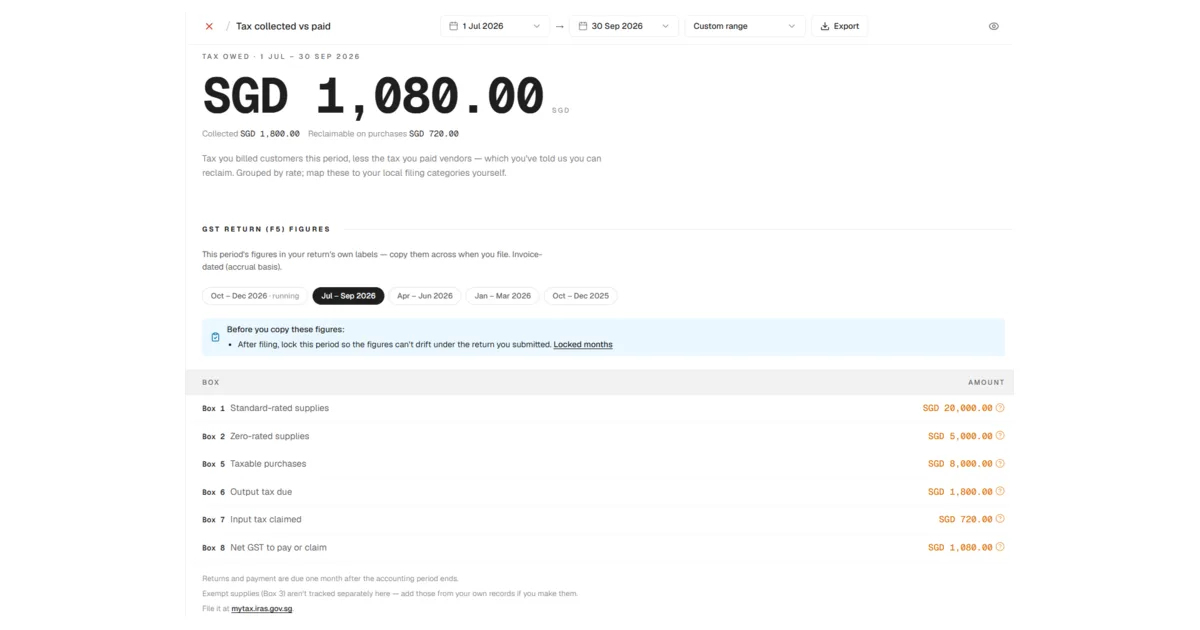
These are the figures from the example quarter above: the same four sales and three purchases, with the unpaid SEO audit included because the invoice was issued in September. The card also notes when the return is due and links straight to myTax Portal, where you file.
Before you file, the card lists anything that could make the figures wrong: draft invoices or bills dated in the quarter that haven't been issued, expenses still waiting for approval, and bank transactions with no record behind them. Each one links to where you fix it. Here, the only item left is the reminder to lock the period once you've filed, so nothing recorded later can quietly change the figures under the return you submitted.
Further down the same report, the figures are broken out by tax rate, so you can trace every box back to the documents behind it.
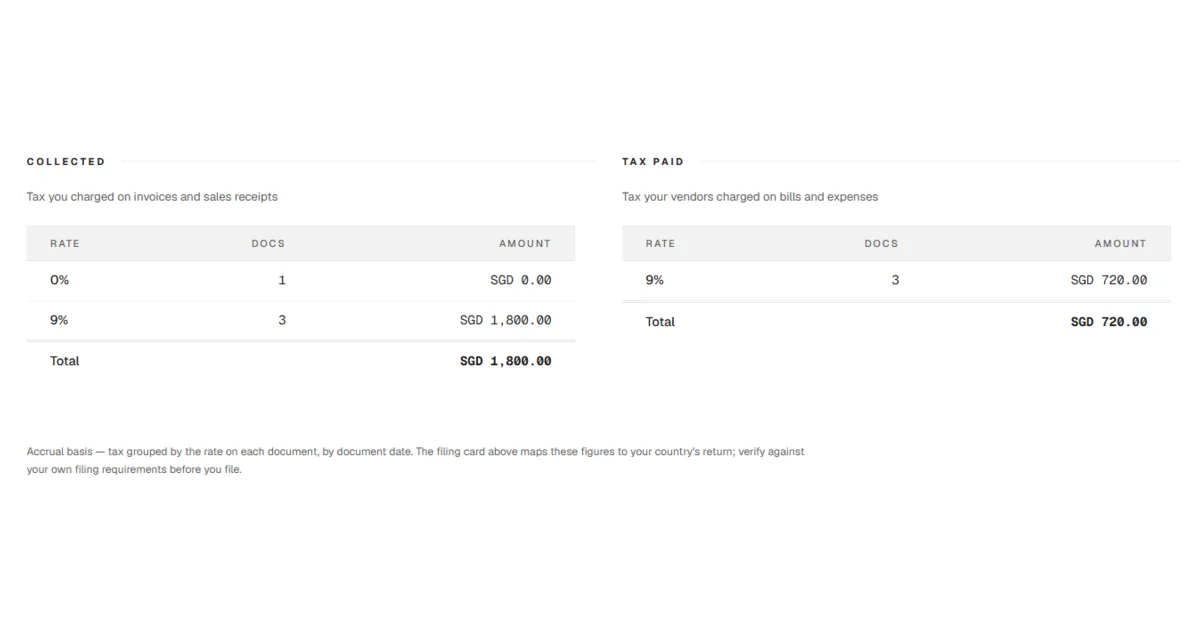
The three 9% invoices are the bakery, the gym and the freight firm, which together carry the S$1,800 in Box 6. The single 0% invoice is the zero-rated sale to the Australian company, which is why it adds nothing to the GST collected but still shows up in Box 2. On the purchase side, the three 9% bills carry the S$720 claimed in Box 7. If a box ever looks wrong, this breakdown is the quickest place to find the document causing it.
To keep a copy, or to hand the figures to your accountant, export the summary as a PDF or CSV. The PDF prints the period dates at the top of the page, so there's no doubt which quarter it covers.
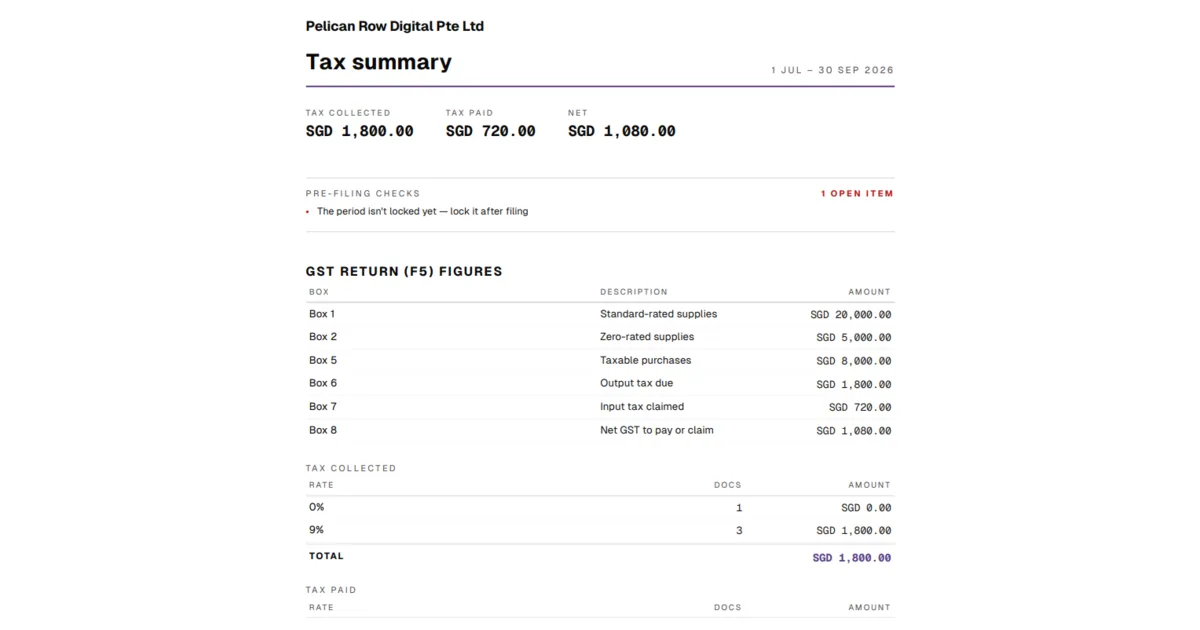
Papertools gives you the figures; the filing stays with you. You log in to myTax Portal and enter them yourself, or pass them to your accountant.
If you'd rather not build your next F5 by hand, start free with Papertools and choose Singapore when you create your workspace. The Essential plan is free forever, with no credit card, and the F5 card is included from your first invoice.
What this won't fix
- Boxes 3, 4 and 9 onward. The card doesn't track exempt supplies, so if you make any, add them to Box 3 from your own records. Box 4 is then Box 1 + 2 + 3. The later boxes cover special situations you'll need to check yourself.
- Purchases from suppliers who aren't GST-registered. Papertools builds Box 5 from the purchases you record. If you've recorded purchases from suppliers who don't charge GST, check Box 5 before you file and take those out.
- The Cash Accounting Scheme. The figures are invoice-dated. If IRAS has approved you for cash accounting, adjust them for invoices that weren't paid within the quarter.
- Whether something is zero-rated. Papertools reports what you've recorded. Deciding whether a sale qualifies for zero-rating is a judgment you, or your accountant, have to make.
Quick answers
Does Box 1 include GST? No. Box 1 is the value of your standard-rated sales before GST. The GST goes in Box 6.
Do I put everything I spent in Box 5? No. Box 5 covers purchases from GST-registered suppliers that carried claimable GST, plus zero-rated purchases, all excluding GST. Purchases from suppliers who aren't GST-registered, and exempt purchases, stay out.
I had no sales this quarter. Do I still file? Yes. IRAS requires a Nil return for any period with no business activity.
Can I zero-rate any customer who's overseas? Not automatically. The service has to meet the international services conditions in section 21(3) of the GST Act, which generally means it's contracted by and directly benefits a person outside Singapore.
When is my July to September return due? 31 October, for both the return and the payment.
How do I file the GST F5? Log in to myTax Portal with Singpass, choose to file a GST return for the period, enter your box figures and submit. You need to be authorised for your business's GST filing in Corppass first. Payment can be made by GIRO, PayNow QR or internet banking.
Where to go next
- Papertools for Singapore: how Papertools works for Singapore businesses, including GST and the F5 card
- Filing your tax return with Papertools: the Help guide to the Tax summary and the per-country filing cards
- Simpler BAS explained: what goes in G1, 1A and 1B: the same return walked through for Australia
- Making Tax Digital for VAT: how your figures reach HMRC: VAT returns in the UK
- VAT3 return explained: what goes in T1, T2, T3 and T4: VAT returns in Ireland
- GST/HST return explained: lines 101, 105, 108 and 109: GST/HST returns in Canada
- IRAS: Completing GST returns: the official box-by-box guide
- IRAS: When to report supplies in GST returns: the time of supply rules
- IRAS: Providing international services: when services can be zero-rated
- IRAS: Cash Accounting Scheme: who qualifies and how to apply
- IRAS: Late filing of GST returns: penalties and what to do if you're late
This article is general information about how tax rules work, not tax, accounting or legal advice. Rules and thresholds change, and how they apply depends on your business. Check the official guidance linked above, or speak to a qualified adviser, before acting on anything here. Papertools gives you the figures; the decisions and the filing stay with you.