Invoice Payment Terms: Should You Use Net 7, 15, or 30?
Net 30 is the default most small businesses inherit, and it's usually the wrong one. How to pick payment terms that match your customers and your cash cycle, and where to write them so they hold.
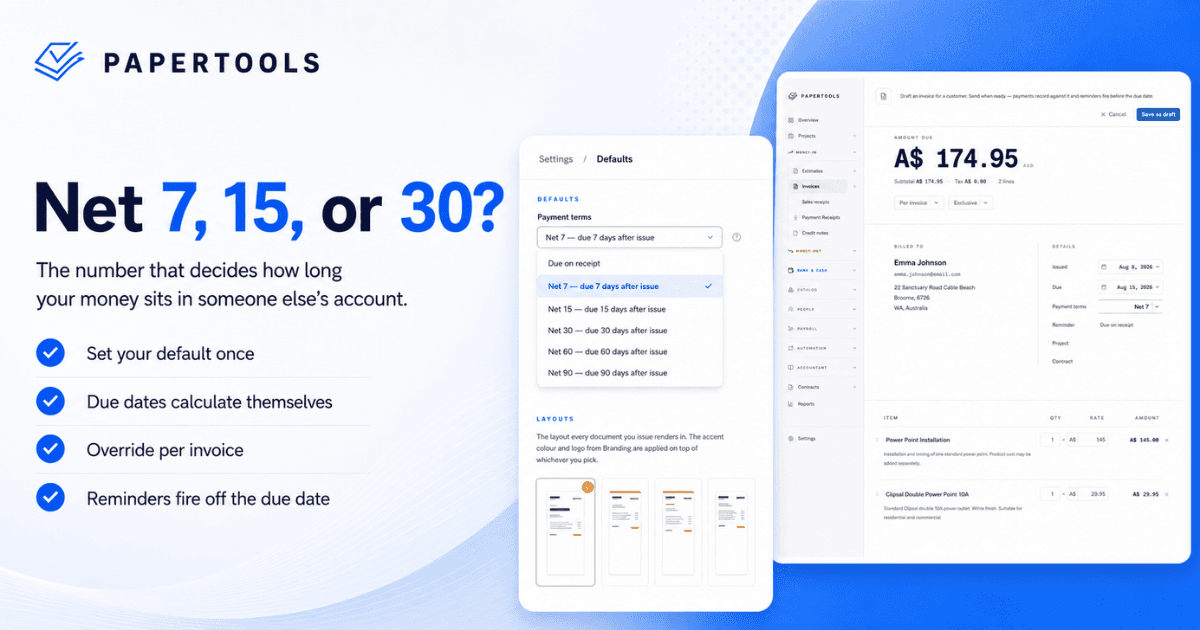
Payment terms are the number of days a customer has to pay you after you invoice them. Net 15 means fifteen days from the invoice date. Net 30 means thirty. Due on receipt means now.
Most small businesses pick a number once, at the very beginning, without much thought — and then live with the cash flow consequences for years. It's worth ten minutes of thought, because this single number decides how long your money sits in someone else's account.
Why Net 30 became the default, and why it probably isn't yours
Thirty days is the number most people reach for, and it's the wrong starting point for a small business.
Net 30 exists because large organizations run accounts payable in monthly cycles. Invoices get batched, approved, and paid in a scheduled run. Thirty days is roughly how long that machinery takes, so thirty days became the convention — for companies whose suppliers can afford to wait a month.
You are not that company. When a customer takes thirty days to pay a $2,000 invoice, you have loaned them $2,000 for a month, interest-free, while still covering your own materials, wages, and rent. Offering longer terms than you need is a financing decision dressed up as a formality.
Shorter terms also rarely cost you work. Small business customers are not comparing payment terms across quotes the way they compare price and availability. In most trades and services, nobody has ever lost a job over Net 15.
Choosing your number
Three questions settle it.
Who is the customer? A homeowner or a sole trader can pay the day they get the invoice. A mid-sized business with one bookkeeper can manage a week or two. A large corporate with a formal accounts payable department will pay on their cycle whatever you write, so with those, thirty days is realism rather than generosity.
How long is your own cash cycle? If you buy materials up front and pay staff weekly, money going out moves faster than Net 30 lets money come in. Your terms need to be shorter than the gap you can comfortably fund.
How much is at stake? A $200 invoice going late is an annoyance. A $20,000 invoice going late is a crisis. Larger jobs deserve shorter terms, a deposit, or both.
A workable default for most small businesses:
- Due on receipt — retail, one-off jobs, anything where you're standing in front of the customer
- Net 7 — regular customers, small recurring work, trades doing domestic jobs
- Net 15 — the sensible default for most business customers
- Net 30 — large corporate clients, or where a contract requires it
- Net 60 or 90 — only where a contract forces it; treat these as financing you're providing, and price accordingly
Pick one as your standard and treat the others as exceptions you make deliberately.
Deposits do more than terms ever will
For any job above a threshold you set, take a deposit before you start. Thirty to fifty percent is normal in most trades.
A deposit covers your materials and your exposure, but the more valuable thing it does is tell you early who you're dealing with. A customer who delays a deposit will delay the final invoice. Finding that out before you've spent three weeks on the job is worth more than any payment term.
Where "due on receipt" backfires
Due on receipt is the fastest option and it works well for retail and consumer jobs. For business customers it can quietly work against you.
A business customer's accounts payable process needs a due date to schedule against. "Due on receipt" gives them nothing to put in the system, so the invoice sits until someone decides what to do with it — which is usually later than a clearly dated Net 7 would have been. Against a business, a real date beats urgency.
Write it where they'll agree to it
Terms that first appear on the invoice are terms nobody agreed to. That's why they get ignored.
Your payment terms belong on the quote, in the same position every time, in plain language:
Payment terms: Net 15 from invoice date. A 30% deposit is required before work begins. Work may be paused on accounts more than 30 days overdue.
Three sentences, agreed before anyone starts. When an invoice goes unpaid later, you're referring back to something the customer accepted rather than introducing a rule after the fact.
Setting it once in Papertools
Your payment terms should be a decision you make one time, not a field you fill in on every invoice.
In Papertools, default terms live in your workspace settings alongside your document numbering. Set Net 15 once and every new invoice carries it. When a particular job needs something different, you change it on that invoice without touching the default.
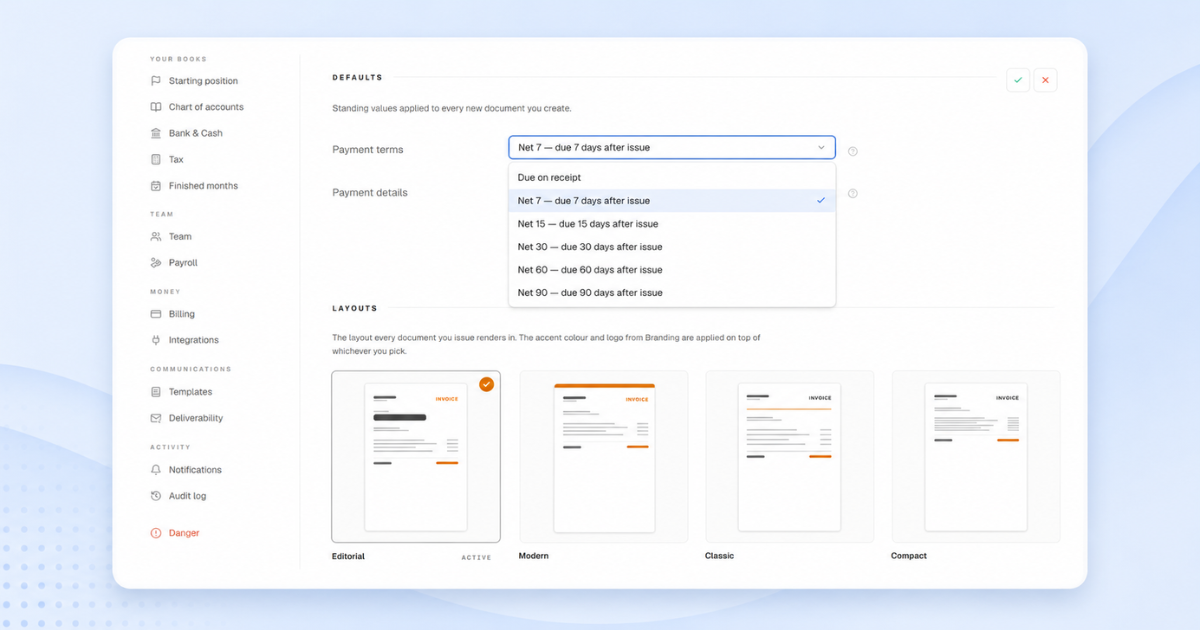
The due date is then calculated for you and printed as a real calendar date rather than a term the customer has to work out. Issue on the 8th on Net 7 and the invoice says due the 15th.
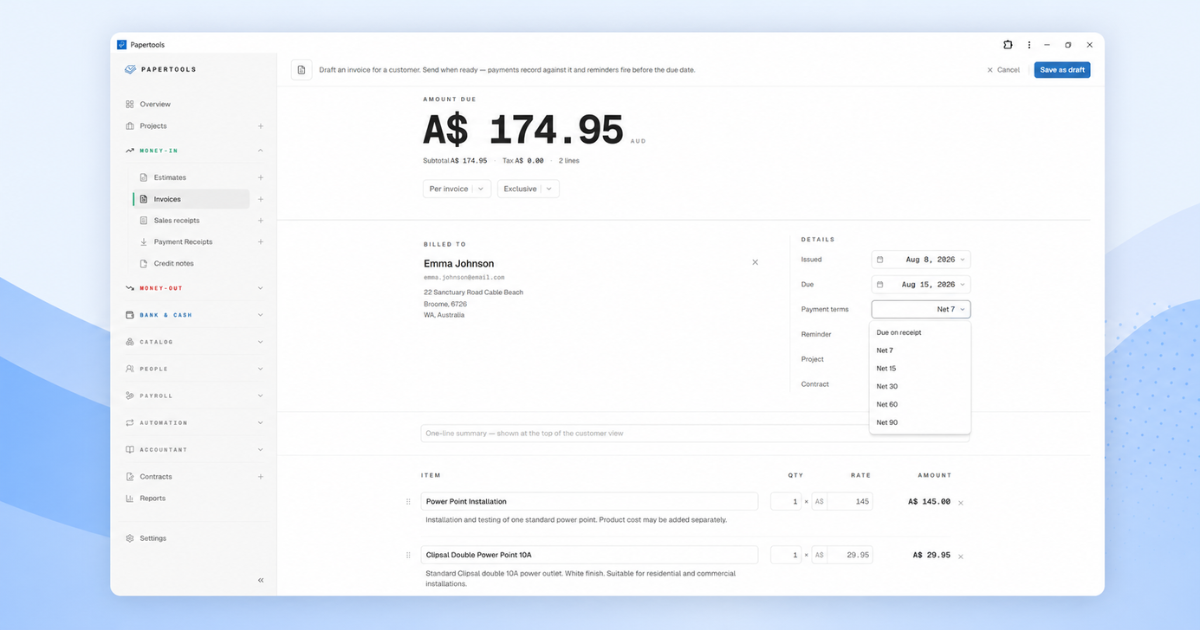
Because the due date is a real date, everything downstream can act on it. The courtesy reminder fires a set number of days before it. The overdue chase starts after it. The aging report groups by how far past it each invoice has drifted. A vague term produces none of that.
Essential is free forever with no card and no trial countdown, which is enough to set your terms up properly and run a real month of invoices through before you decide anything.
What this won't fix
Terms are an agreement, not an enforcement mechanism.
They won't accelerate a large corporate client whose payment run is monthly regardless of what your invoice says. They won't help with a customer who has no money — at that point the decision is whether to void, credit, or write the invoice off. And they carry no weight at all if they were never agreed in writing — which is the whole argument for putting them on the quote rather than discovering the problem at day forty.
What they do is remove ambiguity, and ambiguity is what most late payments are actually made of.
Where to go next
- How to Get Clients to Pay Invoices on Time — the full process these terms sit inside
- How to Write a Late Payment Reminder Email (4 Templates) — what to send when the date passes
- What to Do When a Client Won't Pay an Invoice — what to do with the invoice when the terms didn't hold
- Set your numbering and payment terms — apply your terms to every invoice automatically
- Let customers pay online — shorter terms work better when paying takes seconds